Accuphase P-300L
Beschrijving / Description
Based on the P-300X, this is the 4th generation stereo power amplifier of the P-300 series that has been improved by renewing the detailed circuit, materials used and construction.
The output stage has a 5-parallel configuration with 10 transistors with a Pc (collector loss) of 100W. The total Pc is equivalent to 1000W. By mounting these on a large aluminum heat sink, sufficient heat radiation is achieved and a large output is achieved. By combining this high-power output stage with a powerful power supply, it is compatible with a low impedance load of 2 ohm.
In addition, a non-switching distortion design is applied to improve the distortion at the time of small signal.
Power MOS FET is used for the drive stage that drives the output stage, and it is composed of cascode push-pull with excellent high-frequency characteristics.
In addition, the pre-drive stage that sends a signal to the MOS FET drive stage is also A-class cascode push-pull to improve the element characteristics.
The input circuit constitutes a cascode bootstrap push-pull circuit.
The cascode bootstrap circuit has the ideal characteristics as an input circuit, such as high gain, excellent high-frequency characteristics, and no degradation of the distortion factor against the fluctuation of the input impedance.
In the P-300L, for further completeness, this circuit is constructed by push-pull to improve the element characteristics in the NF loop.
It uses a direct connection system in which input signals are directly input.
In this case, the DC servo system is used to cut off the direct current to prevent damage to the speaker caused by amplification and output of a pre-amplifier with large DC drift. This DC servo system stabilizes the DC drift caused by temperature change of the amplifier itself.
In addition to the unbalanced input by the normal phono jack, it is equipped with a full-scale 600 ohm balanced input (canon type).
The balanced input generates and transmits positive and negative signals of the same voltage with respect to the ground potential, and receives them by a differential amplifier or a balanced transformer. Even if an external induction is received in the middle of the transmission system, it is generated in phase in the positive and negative paths, reversed by the phase inversion circuit of the input stage and canceled out, and does not appear on the output. Therefore, it is possible to minimize the sound quality degradation caused by the induction.
In the P-300L, the phase of the input is inverted by a low-differential-band amplifier circuit.
Equipped with bridge connection circuit, it can also be used as a monaural power amplifier.
Bridge connection is a method in which the voltage applied to the speaker is doubled and the output is increased by four times by inputting the same waveform and accurate opposite phase signals to each amplifier and connecting the speakers to the output terminals of both amplifiers.
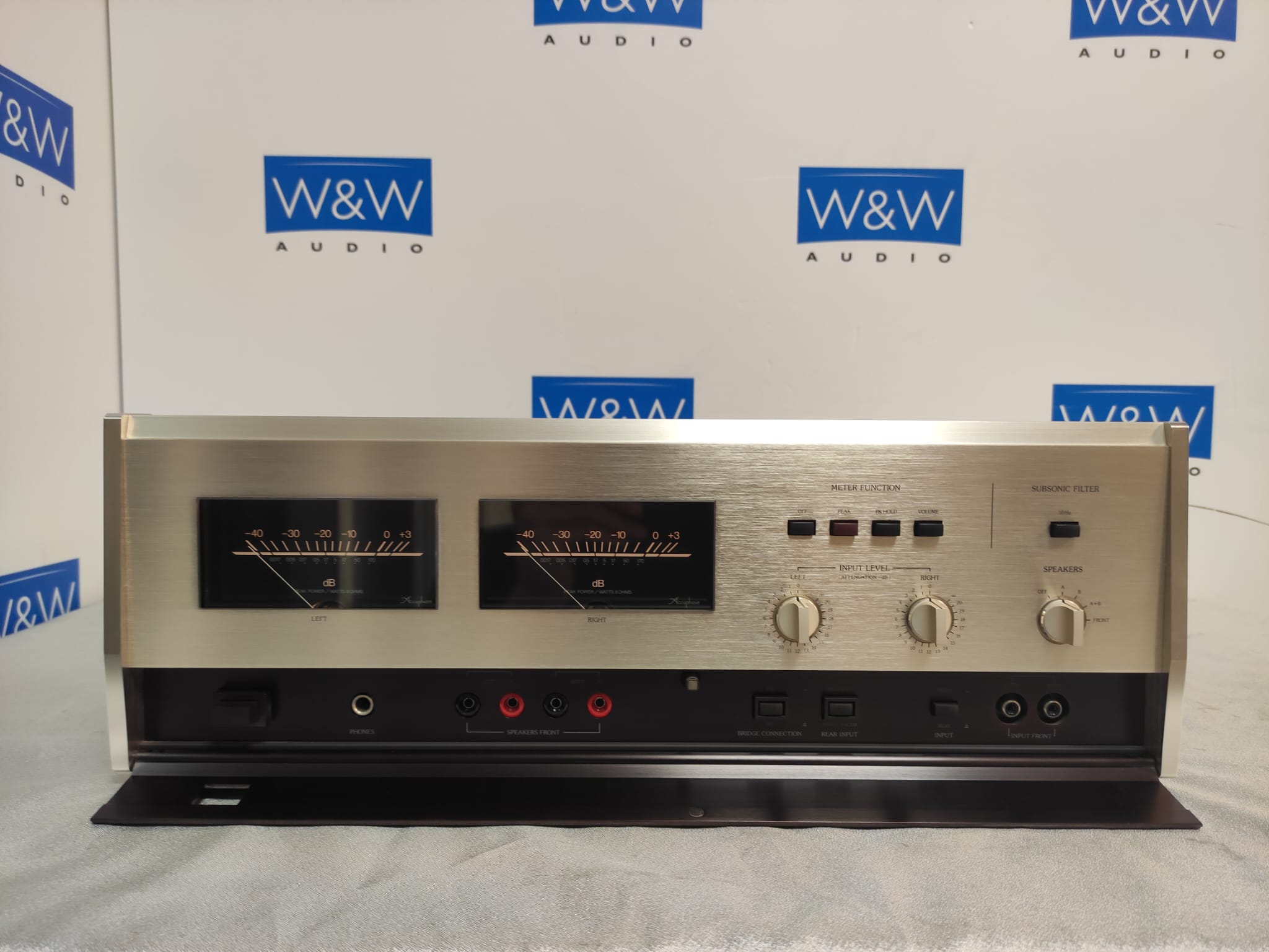
Equipped with a peak power meter convenient for monitoring.
Logarithmic compression type that can continuously read the entire output range, and can directly read the output power of 8 ohm load with dB scale.
The meter function selector switch enables peak holding, resetting every 3 seconds, and displaying the peak value during this period.
The input / output section is also provided in the front sub-panel, which can be used for equipment testing.



Specificaties / Specifications
Power output: 170 watts per channel into 8 ohm (stereo), 500 watts into 8 ohm (mono)
Frequency response: 20Hz to 20kHz
Total harmonic distortion: 0.01%
Damping factor: 300
Input sensitivity: 1.5V
Signal to noise ratio: 120dB
Speaker load impedance: 2 to 16 ohm
Semiconductors: 56 x transistors, 12 x FET, 8 x IC, 78 x diodes
Dimensions: 445 x 160 x 373mm
Weight: 23kg
See also link.
Controleer onderstaande links met onze honderden occasions of het item nog te koop is.
Please check the links with our hundreds of occasions below if this occasion is still for sale.


